Showing posts with label Customs. Show all posts

Sunday, March 23, 2014

Hand Gestures and Using Two Hands in Korea

Something that you will probably see a lot of in Korea is people doing strange things with their second hand when giving things to people. Just like bowing, this is used as a sign of respect. When you give something or receive something from someone who is older OR more senior you should use two hands. At my school when I hand out worksheets my students always take the work sheet from me using two hands. If you are in business and are accepting/handing out a business card, always use two hands. You can find more about giving/receiving business cards here.

You have a few options here.
1) You can accept/pass the object (i.e. piece of paper) with both hands as you receive it.

2) You can accept/pass the object with just one hand and touch any part of your arm between the wrist and the elbow with your second hand.

3) You can accept/pass the object with just one hand and bring your second hand in to wrest on the side of your rib cage just below your armpit. You will look like you have stomach pains, but it is considered polite. Personally, I go with option 1 or 2. 

If you are unsure if you should use two hands, then use two hands. You will never offend someone by offering or receiving something using two hands. Worst case they might think you are a little strange.

Here is a video from EatYourKimchi on hand gestures.

Receiving a Business Card in Korea

I won't reiterate the rules about using two hands, but I felt I should add a couple more important notes when giving/accepting business cards.

Even though many Korean businesses litter the sidewalk with business cards (either by high speed scooter or someone walking and randomly dropping piles of business cards at your door), if someone hands you their business card and you would like to do business with them someday you need to be super respectful.

1) Use two hands
2) Treat it like they have given you something amazing. Spend some time looking at it and maybe even comment on how nice the design is.
3) Make sure they see you put it in your wallet.
4) When you put it in your wallet, don't stuff it in the back with all the other cards. Put it in the front in the high use zone (where you stick things like credit cards). 

These rules may sound silly, but they can go a long way to building a successful business relationship with someone. 

Now... up until now it all makes sense right? It is a little over the top but you can see where they are coming from. This is the crazy thing. In Korea (I am unsure about other Asian countries) businesses will often pay scooter drivers to drive around the streets with huge wads of business cards to ninja throw at doors. 

The picture above is the front door to my apartment building. I have never seen anyone pick these up to do anything other than throw them in the bin. Why on earth would someone pick something up that has been on the filthy ground? It is a huge waste and frankly I view it as littering. Not only that, but given what I said about treating business cards like they are something special, this seems highly illogical doesn't it. Welcome to Korea. 

Saturday, October 19, 2013

Breaking The Basket Ceremony (함받기)

Last weekend I met some more of Jihyeon's relatives in Iksan for a strange ceremony that roughly translates as "breaking the basket" (함받기). The ceremony is mean to symbolize breaking bad luck and ensure the couple of a prosperous future together. 

Traditionally, before the wedding, the groom's family would send presents to the bride and her family in a box called a Ham. Additionally, the Hamjinabi (person who delivered the Ham) and a small group of close friends of the groom would also deliver a pot of Bongch'i Deok (red bean rice cake) from the groom's family. The brides family would have a small party for the group, offering them food and drink for their efforts. The ceremony of delivering the Ham has evolved into a major event for friends of the groom, with the bearers "selling" the contents of the Ham to the bride's parents. In recent years the groups have become very boisterous and demanded large sums of money... which is then promptly spent on alcohol.

I wasn't allowed into the apartment until I put on my hanbok and broke the basket in the doorway. My only option? Get dressed in the stair well. 


That's the "basket" on the floor in the doorway. It's not actually a basket, it is more like a bowl made out of a hollowed out gourd. Ideally you are meant to break it on the first try. 


RAWR!!!!!


I then had to bring the suitcase (known as the ham) filled with gifts for Jihyeon into the apartment. 


And take my shoes off. You can see the broken basket/gourd on the floor. 


I had to wait for Jihyeon to get changed into her hanbok.


Jihyeon's parents then sat down. That is a giant rice cake on the table. 


And then Jihyeon and I had to do a "big bow". 


Rice cake^^.


The front door was left open to welcome the other visitors (aunts and uncles) who were yet to arrive. 


An up close of a broken fragment of the broken basket/gourd. 


And then once the aunts and uncles arrived, it was dinner time. Food glorious food.


After dinner Jihyeon's father opened the suitcase that contained the gifts for Jihyeon (the wedding rings and a dress) and a letter written using Chinese characters (the alphabet Korea used thousands of years ago).


And this is the letter. This is known as the Honseo (marrage paper). It is wrapped in black silk and states the name of the sender (my father) and the purpose of sending (marriage) between myself and Jihyeon. It symbloizes the dedication of the wife to only one husband. The wife is to keep this document with her forever, having it buried with her when she dies. 


I'll try and dig up some more info on this custom, but that's all I have for now.

Sunday, September 22, 2013

My First Chuseok (Korean Thanksgiving)

While other western teachers were busy traveling Korea or various exotic destinations around Asia on their 5 day weekend, I was fully immersed in chuseok (Korean Thanksgiving). Chuseok (추석) is a major harvest festival and 3 day holiday in Korea celebrated on the 15th day of the 8th lunar month. Up until only a few decades ago Korea was still a heavily agrarian society so celebrating a good harvest is still an central part of Korean culture. During chuseok Koreans visit their ancestral hometowns and share a feast of Korean traditional foods. 


There are a couple of theories on how and when chuseok originated, but the most popular theory is that it started 2000 years ago as a weaving competition when two teams would go head to head in a month long weaving competition. The team that had woven the most cloth was declared the victor and was treated to a feast by the losing team. 

In modern South Korea, on Chuseok there is a mass exodus of Koreans as they return to their hometowns to pay respects to the spirits of their ancestors. Early in the morning (before breakfast) people perform ancestral worship rituals and then later in the day visit the tombs of their immediate ancestors to trim the grass and clean the area around the tomb. They also take some food and drink to offer to their ancestors to show their thanks to their ancestors for blessing their harvest. 


In modern (or maybe I should say backward) North Korea things are a little different. I was naive to think that chuseok, something of central importance to a Korean, would be one of the few things the two countries still shared. Sadly, that is not the case. North Koreans are indoctrinated that they should be thankful to their great leader, not their ancestors, for the food on their table. Up until 1988 North Korea did not celebrate chuseok. Korea times reported that north Koreans now highlight Chuseok with a visit to the graves of the founding members of North Korea and relatives of Kim Jong-il. But even this 'honor' is reserved for the upper class in North Korea. Generally chuseok celebrations in North Korea are very low key due to the general lack of food for the 12 million (50%) people living in extreme poverty and government restrictions on travel between districts


Enough History. Time for some photos. 


As I have touched on in previous blog posts, gift giving in Korea is an integral part of life. Chuseok is no different. In western countries you know Christmas is just around the corner when stores start playing Christmas music and hanging decorations. In Korea you know when chuseok is around the corner when stores bring out their over priced gift boxes of food, shampoo, alcohol, well being medicines (ginseng/vitamins/etc), soaps and my favorite.... SPAM. Yes, that's right. You want to show someone you care, buy them a gift box of SPAM.  


SPAAAAAAM


Rocket fuel (aka Soju)


Shampoo and other bathroom products


Dried anchovies


Genseng


This year the chuseok holiday fell on Wednesday, Thursday and Friday which is good because it meant a loooooooong weekend^^ and we didn't lose a any days due to the holiday falling on a weekend. In Australia if a public holiday falls on a weekend we get the following Monday off. No such luck in Korea. If it falls on the weekend, it's gone forever. 

Early Wednesday morning I traveled to Iksan. When I arrived Jihyeon's mother and aunt were had been up since the crack of dawn busy preparing food. I arrived to find them out on the balcony floor making Sanjeok which is grilled meat (beef, chicken, spam, prawns, fish) and vegetables dredged with flour before cooking. 


Next up was Songpyeon which is a half moon shaped rice cake with sweet or semi-sweet fillings such as red bean paste, chestnut paste or sesame seeds and honey. Jihyeon's mum was an expert at it. 


You start with a big ball of mushed up rice.


You take a small piece and make it into a cone shape to hold the fillings. 


You add the fillings.


and then seal it up. 


I decided to try my hand at it.  


After much cursing and frustration you have a neat row of songpyeon^^. 


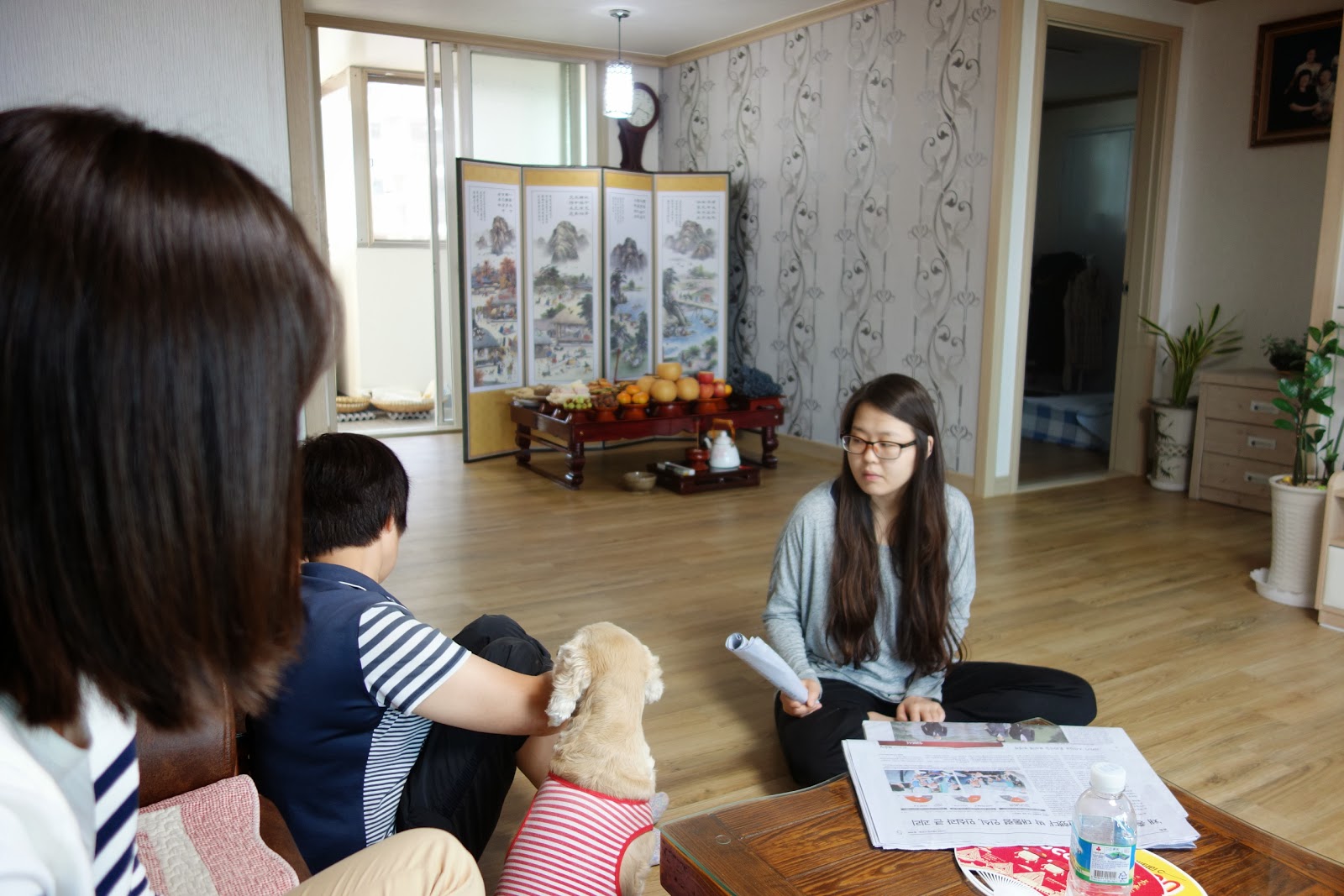
The next morning (Thursday) was Chuseok (Thanksgiving day). I woke up to find Jihyeon's mother had been busy preparing the table so they could perform the perform ancestral worship ritual. Food is arranged on the table according to local customs, but generally fruit goes to the south of the table while behind that are vegetables. To the north of the table is rice and soup. The placement of the meat (chicken and fish) various from region to region. Soju or Makgeolli is placed on a tray at the front of the table with an incense stick standing in a small bowl of uncooked rice. You can see in the rice to the north of the table some spoons standing upright and some chopsticks resting on the Sanjeok. This is so the spirit of the their ancestors can come and enjoy the food. 


The family members then perform what is known as a "big bow" to honor their ancestors. 


After people have bowed you then need to sit around (for about 15 or 20 minutes) to give the spirit of the ancestors time to enjoy the food. 


Once the spirits have had time to chow down on the food, it was time to put some soup on the table and move the chopsticks from the Sanjeok to the fish so the ancestors could eat something different. 


Jihyeon's father also put some of the rice into the soup. 


After another 15 or 20 minutes the table was cleared


and set for breakfast. 


Mmmm. Breakfast^^.


After breakfast we drove to the cemetery where Jihyeon's fathers parents are buried. 


That is Jihyeon's uncle in the truck.


The cemetery was super busy and police had closed off all the roads making it safe and convenient for flower stalls to set up at the entrance. 


The cemetery was quite large. Something I just noticed looking at this picture is all the tomb stones are identical in size and shape. 


We walked to the middle of the cemetery where there was a large building that housed the ashes of thousands of people. 


And here are Jihyeon's grandparents. 


After paying respects to them we drove for another 45 minutes for the cemetery for Jihyeon's mothers parents. It wasn't as big as the first cemetery and was hidden away in the mountain side. We started walking up a narrow dirt road.


That turned into a narrow overgrown dirt track.


The grave was over the other side of this hill. The path got very steep so I offered my hand to Jihyeon's mother to help her up the steep hill (her knees and back are not terribly good) and I got a real surprise. She spoke her first ever English to me. She said loudly and very clearly "Thank you". ^^


On the way we passed some other graves where families were hard at work cutting back the grass and weeds. We finally arrived. Jihyeon's mothers older brother had been here a week earlier and trimmed the grass back so it looked in great condition and very neat. They set about putting some food and soju out in front of the grave. 


And then after a few minutes packed the food up and poured the soju over the mound. 


From the grave we saw an easier path (a farmers road through some rice fields) back to the main road to where we had parked. 


Later that night I went up the the roof of Jihyeon's apartment building in Iksan to try taking a photo of the full moon. The moon was too bright for my poor little camera, but I think the city came out well. 


The next day (Friday) we piled into the car again and traveled to the war cemetery where Jihyeon's uncle is buried. 


The traffic was terrible. After about 30 minutes we found a car park and started walking up the mountain. 


Again we set up some food and poured some soju for her uncle. 


The giant yellow thing between the apple and the grapes is a Korean pear. In front of the pear is some dried fish. 


We then found a shady spot to have a snack and re-hydrate before getting back in the car for the long trip home. 


Overall I thought Chuseok was interesting. It was very different to anything that we have in Australia and I liked the strong emphasis that Koreans put on making a pilgrimage to visit the graves of loved ones once a year. My only disappointment is that we didn't play a Korean card game called go-stop. Oh well. Maybe next year.