Thursday, October 9, 2014

The East Sea

After visiting the Royal Tomb of King Sejong the Great, we continued eastward in the heavy traffic.


Later in the evening we stopped at a market place to buy some fried chicken and hotteok.  


There were lots of places selling fried chicken. We chose to stop at the busiest shop and try some of their free samples. It was good, so we joined the queue to buy some. 


Fresh made hotteok (tastes a lot like a doughnut). 


Finally, after being on the road for hours, we arrived about 7pm.


Yum, can't wait to eat! 


After dinner we decided to set some fireworks off at the beach. In Australia fireworks are illegal (without a licence) so lighting my own fireworks was a novelty for me. They were between 2000won ($2) and 4000won ($4) each. 


I chose one of each the convenience store had on offer...


And we headed down to the beach to light them up!


Mwahahahaha


My first firework. We decided to start with the cheapest and work our way up.


It was OK, but a little disappointing. 


My second firework. This one was filled with 30 firework shots. It shot each one about 15m into the air.


It was a little disappointing. 


The third one was a little better, though you wouldn't know it from the photos. 


The final and most expensive one (cost 4000won). It was similar to the second firework, but instead of containing 30 shots, it only had 15. 


Wow, much better. 


Afterwards, we walked along the beach. 


A ferry out on the water put on a fireworks show.  


The next morning we started the long journey back to Suwon. 


On the way back to Suwon, we stopped off at another beach which was better than the one we visited last night, but still not particularly good when compared to what we have in Australia.  


My mother-in-law was excited though. 


We took Haru (their dog) for a walk along the beach.  


We then started heading west and climbed the mountain range once again. At the top, we stopped at a lookout. 


Wind turbine near PyeongChang, the city where the 2018 winter olympics will be held. We stopped here to visit a sheep farm, something that is a novelty for Koreans. Having grown up on a farm in Australia I wasn't terribly excited, but I seized the opportunity to stretch my legs. 


It was crazy busy. The farm must make an absolute fortune. At 4000won ($4) per person for entry, they would have been rolling in money. There was a steady stream of people coming. If I had to guess, I would say they took $20,000 in that one day alone!


If you want, you can cash in your ticket for some hay and feed the sheep.  


We decided to climb the mountain to get a view of the farm and the valley. 


Over in the distance on the right is the city of PyeongChang where the 2018 winter Olympics will be held. 


In the distance, you can faintly make out the ski jump ramp. 


Photo at the top of the hill. After taking this photo I spotted someone's wallet in the lush green grass on the other side of the fence. We picked it up, checked it for a business card, and managed to get in touch with a very thankful Korean.  


Last photo before it started raining.


The eastern coast of Korea is one of the nicer places to visit in Korea, just steer clear of it on public holidays and vacation periods as the traffic is horrible. There is definitely a lot of construction going on in the region in preparation for the PyeongChang winter Olympics, so hopefully that will help ease traffic congestion in the future. 

King Sejong the Great's Royal Tomb

Last Friday was public holiday to celebrate Gaecheonjeol (National Foundation Day). This holiday celebrates the creation of the Gojoseon state in 2333BC. The day is also celebrated in North Korea. 

My in-laws were keen to take me to the far eastern part of Korea to see the east sea. The traffic was pretty bad most of the way (being a public holiday), but on the way we stopped to stretch our legs at the Royal Tomb of King Sejong the Great. 

King Sejong the Great was, as his title suggests, one of the greatest and most loved kings in Korean history. He is credited with a lot of advances in science, strengthening the Korean military, and developing positive foreign policies (including encouraging trade with Japan). His biggest lifelong accomplishment was the creation of Hangul, the Korean alphabet. Prior to Hangul, Koreans had relied on Chinese characters to keep records and write laws. King Sejong recognised this as being a problem. Learning Chinese characters was (and still is today) very hard and time consuming, something that only the wealthy could dedicate time to learning. King Sejong recognised that if the poor were to have any chance of becoming educated and fairly being represented in legal disputes, a simple writing system was needed. 

There are actually two kings buried at this site. On the map below, King Sejong is to the left (Yeongneung (영릉)), and King Hyojung is on the right (Nyeongneung (녕릉)). 


Tickets are cheap! Only 500won (50 cents) to enter. 


As you enter, the first thing you will see are a bunch of astronomical measurement units that King Sejong was credited with inventing. 


A statue of King Sejong. 


And my obligatory "look, i'm here" photo. 


There is a small museum with some old paintings and records (written in Chinese). 


We continued walking along the path towards the tomb. On the way we passed a pond with ginormous gold fish, close to 40cm long!  


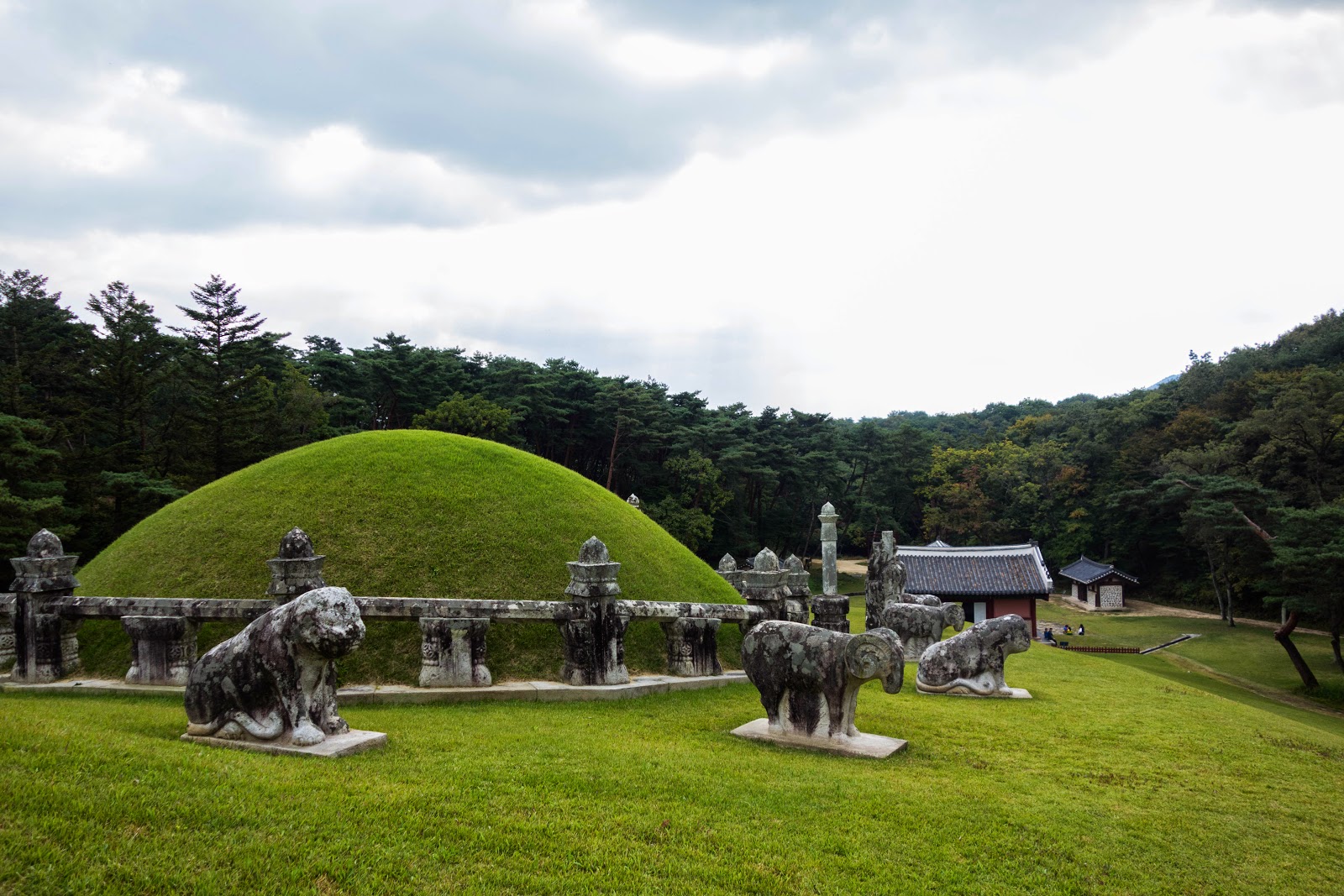
You can see the tomb in the distance (the grassy mound behind the building). 


This building is called Jeongjagak. It is called this because it is shaped like the Chinese letter jeong, which is shaped like the letter T. For anyone who is a regular reader of my blog, you might remember the offering table Koreans make for their ancestors on Chuseok (Korean thanksgiving). That is what this building is for. 


Inside are some tables where the offerings would be laid out. 


Here are the foods put on the table. 


Even today, people still come here to do the offering ceremony to King Sejong. I'm sure this would be a great honor for Koreans which makes me wonder how they choose who gets to do the ceremony. 


Across from the offering building is a small home for the grounds keeper.


View from up top. 


This is a stone warrior to guard the tomb. Behind him is his horse. 


After checking out King Sejong's tomb, we crossed to the other side of the hill to visit the tomb of King Hyojung.


It has a similar layout, with the building for memorial offerings in front of the tomb. 


This is the queens's tomb. 


And here is King Hyojung's tomb (further up the hill because he was more important). 


 King Hyojung's tomb on the right, the queen's tomb on the left. 


Time to head back to the car park.


On the way back, we stopped off at the ritual house for King Hyojung's tomb. This place was used for food preparation and storing offering vessels. Most of the ritual houses attached to the royal tombs of Joseon were destroyed or heavily damaged during the period of Japanese colonial rule and the Korean war. Happily, this ritual house survived. 


There were dragon flies everywhere. One of them finally landed on me long enough for me to take a photo. 


The hill climb back to the car park. 


We then jumped in the car and continued our journey to the eastern coast of Korea. On the way I spotted a prime example of the terrible unsafe driving practices many Koreans engage in. In the car in front of us, two boys (under 10 years old) were standing on the seat poking their heads out the sunroof. 


Stay tuned for an east sea update. 

Saturday, September 27, 2014

Kinball - Teacher Bonding

It's exam time at the moment so all classes are cancelled while students sit exams. This left the teachers with some extra time up their sleeves in the afternoon, so on Thursday they organized a teacher bonding game in the gymnasium. The name of the game was Kinball and is an easy to learn game for the athletically challenged. Spending a decent chunk of my youth playing sport along with my superior genetics (extra long arms and legs) helped me earn the title MVP (most valuable player). 

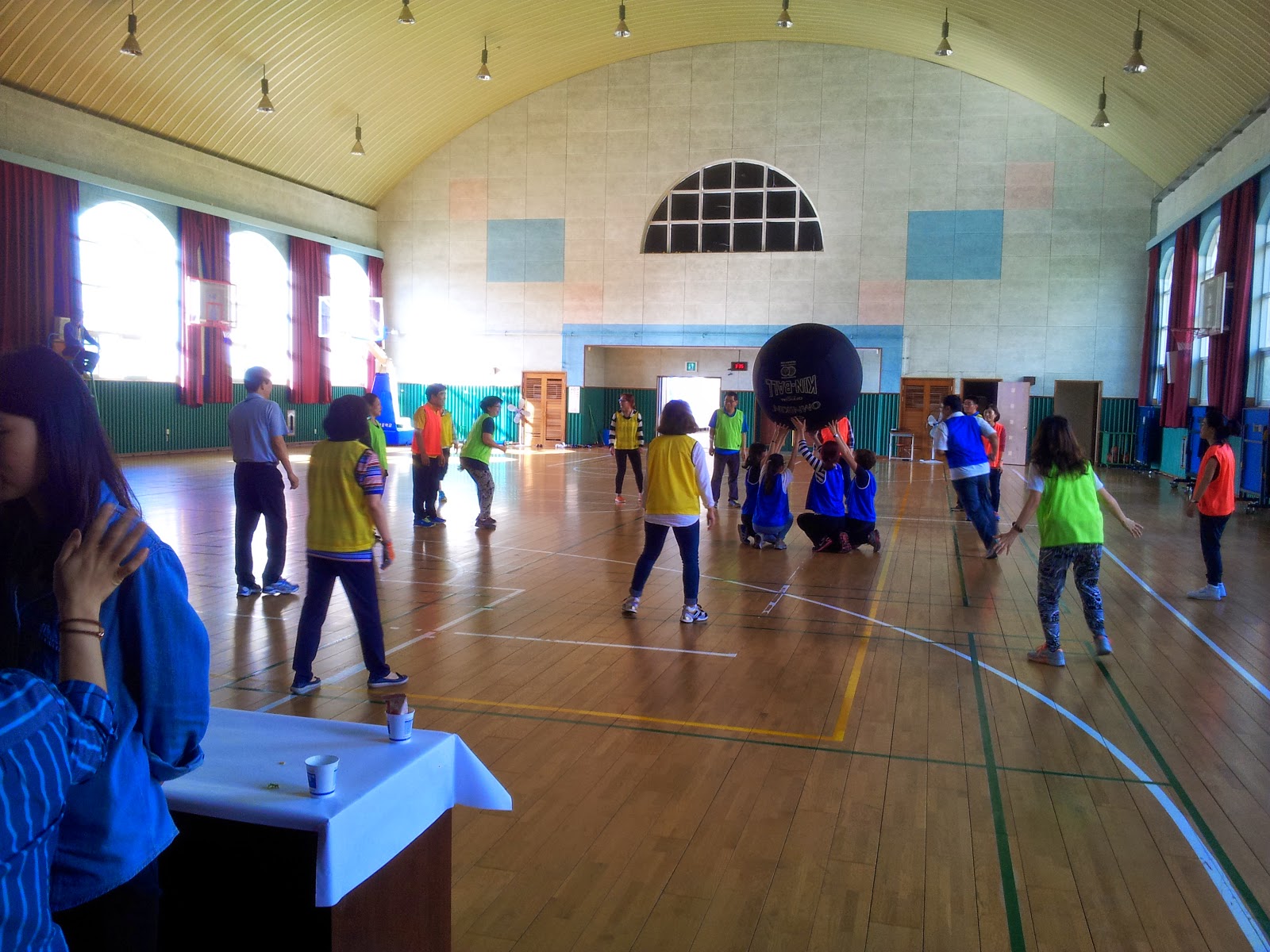
Sitting and listening as the rules are explained to us. Demonstrated below is the technique for serving the ball. All but 1 team member has to hold the ball up above their heads. The other team member then runs in circles around the ball, shouts out the name of one of the other teams before hitting the ball, and that team has to catch the ball before it touches the ground. 


4 teams are on the playing field. One team (yellow) is about to serve, and the other 3 teams (blue, green and orange) position themselves strategically around the ball. 


It's blue teams turn to serve. 


Blue team hit the ball. Green team needs to catch the ball. 


It was an easy game, but fun.